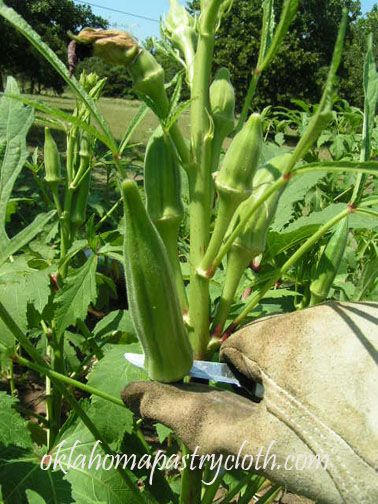
Cutting okra requires gloves and a long-sleeved shirt.

To test for toughness, make a slight cut into the pod. The knife should easily slice through the surface.

Okra flower

The okra pods will be various sizes and you can separate them according to the sizes for particular cooking methods. The smaller pods are great for boiled okra with butter and salt. The medium sizes are great for pickling and all sizes are suitable for frying and soups.

To freeze your okra for frying, cut the pods into bite sized pieces and place into a deep container that can be covered.

Add enough milk to the container to coat the pieces. I like to use buttermilk. Don’t worry about using too much, because you can drain off any excess.

Cover and shake to coat.

Next, add half a cup of flour and a half a cup of cornmeal. Cover the container and shake to coat the okra pieces.

This okra needs more covering so I will add equal amounts of more flour and cornmeal. I do not add salt until after I have cooked okra because salt can make the crust tough.


Cover and shake again. This okra is adequately coated.

Pour okra into shallow cake pans for small freezers, or onto cookie sheets for larger freezers and spread evenly over the surface. Freeze.


When the okra is frozen hard, using hands or slotted spoon, sift frozen okra and place into freezer bags and label. Freeze leftover coating for future okra.

Uncoated okra can be frozen the same way for soups and for the recipe that follows. Do not pre-scald okra to freeze, but just freeze it fresh off the stalk. Placing the pieces on a shallow dish to pre-freeze makes it easy to take out only the amount that you wish to use for each meal. The pieces are not clumped together in a big mess.
One of my favorite ways to make okra was taught me by my mother-in-law who never measured anything. She just brought a basket of goodies in from the garden and started throwing things together. Her version of “Okra and Tomatoes” is great. She used fresh tomatoes, onions, garlic and okra from the garden, but “store-bought” is just fine.
You need one good-sized tomato per person, chopped into small pieces
Around 6 medium okra pods per person
1 medium onion, finely chopped
1 clove garlic, minced
1 tbsp real butter or 1/2 tbsp olive oil
1/4 to 1/2 cup of grated or shredded parmesan cheese, depending on taste
Salt to taste

In a saucepan, saute onion in butter or olive oil until onions are transparent. I use olive oil.

Add garlic and stir.


Add tomatoes and okra and stir until heated.

Lower heat and cover to simmer until okra is tender – about 15 minutes. (a little longer for larger amounts)


Add salt to taste and quickly toss with parmesan cheese to taste. Immediately remove from heat and serve as a side vegetable.

Yummy! Dig in!
Tags: freezing, okra, okra and tomatoes, parmesan cheese, recipe
Great tutorial! I am inspired and my bowl of okra sitting on the counter is destined for the freezer tomorrow. I am going to try to bread some to freeze.
I also love okra and tomatoes and have never made my own. Hopefully will pick more okra tomorrow and give that a try.
I so appreciate you MB!
Okra coffee? I love different coffees, but I’m not so sure about that one!